
Overview
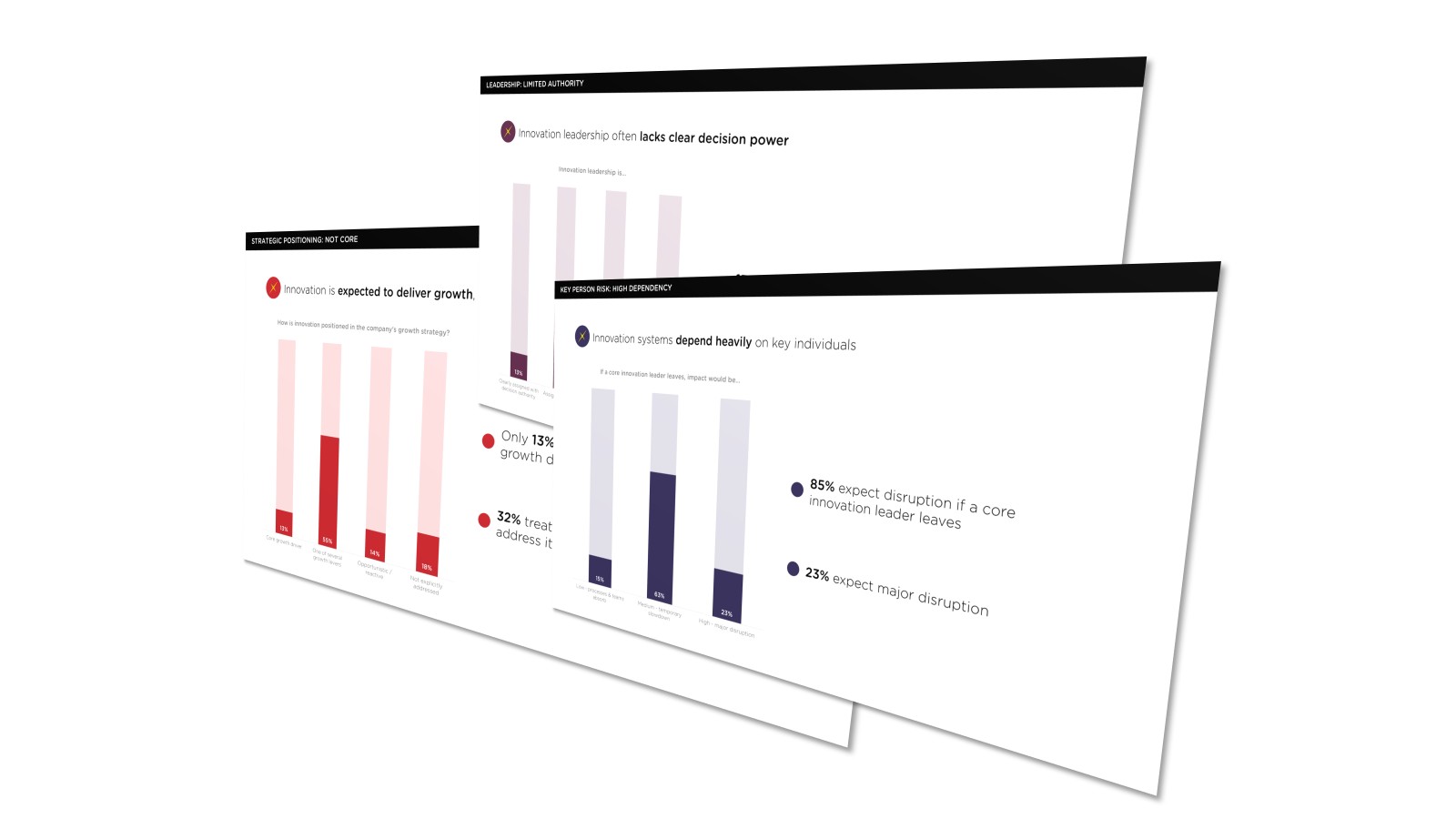
State of Innovation 2026 explores how organizations currently approach innovation across strategy, idea generation, decision-making, leadership, capabilities, investment, and measurement. The report highlights a recurring pattern: companies expect innovation to contribute materially to growth, but often rely on informal structures, limited budgets, and concentrated ownership.
The result is a persistent ambition-capability gap. Innovation is expected to generate meaningful revenue, yet in many organizations it is not positioned as a core growth driver, is slow to validate, and remains difficult to scale systematically.
What you’ll find inside
- Why innovation is often expected to deliver growth without being treated as a core growth driver
- How informal governance, idea flow, and leadership structures limit consistency and scale
- Where companies struggle with prioritization, experimentation speed, and KPI maturity
- How concentration risk, limited skills depth, and modest investment weaken long-term resilience
Key highlights
The report points to four themes: an ambition-capability gap, concentration risk, an incremental output ceiling, and the dominance of informality across strategy, governance, ideation, leadership, and measurement.